Shifting the Paradigm: Designing a Culturally Responsive, Community-Integrated Dementia Village
By Dhenu Patel, Franziska Forsythe, & Keral Mori
How can design bridge the gap between memory care and cultural identity? How do we ensure that a diagnosis of dementia doesn’t mean an end to social life, traditional heritage, or family connection?
These are the core questions our team, Dhenu, Franziska, and Keral, sought to answer for the Fanshawe College Environmental Design Competition. Throughout our journey as undergrads, the three of us have continuously worked on studio projects together. It meant the world to us to close out our degrees by focusing on something deeply personal, drawing on our diverse backgrounds to tackle an under-recognized issue at the intersection of healthcare and urban planning.
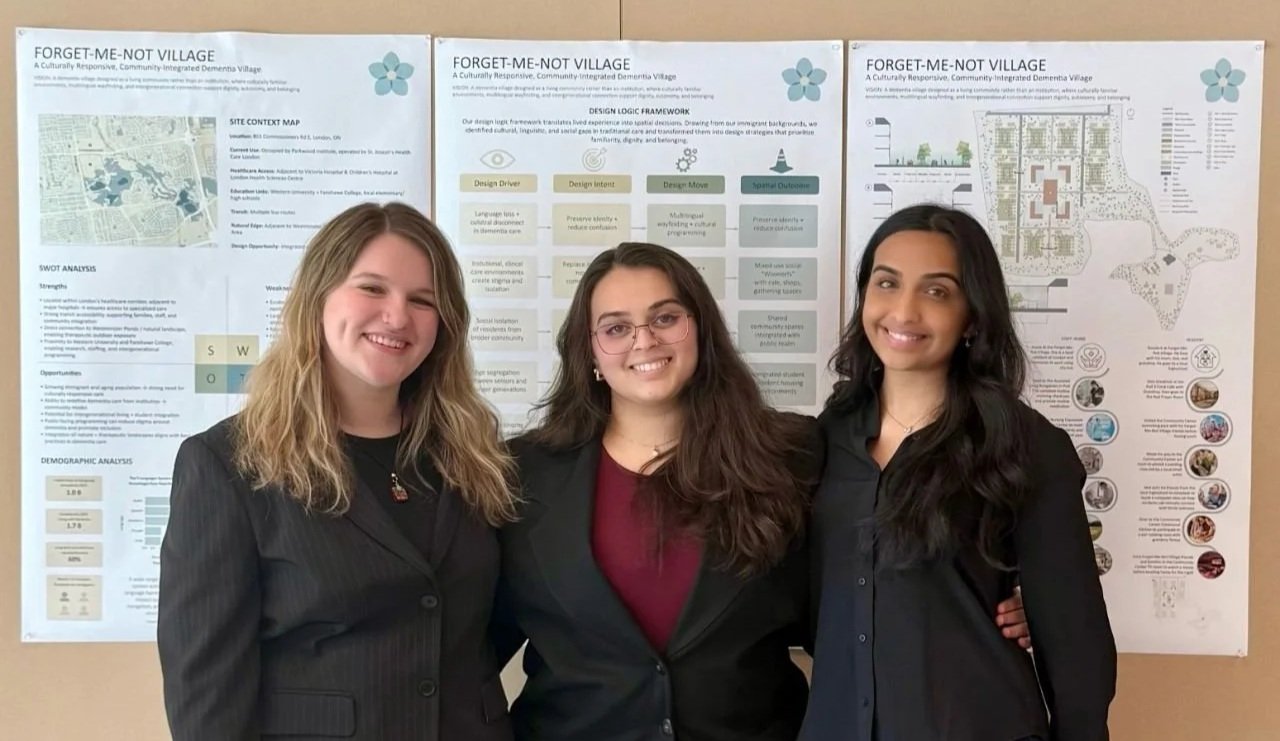
Forget-Me-Not Village project team photo.
Our project, Forget-Me-Not Village, reimagines long-term senior care from the ground up. The project moves away from the traditional, clinical North American care facility and introduces a scalable, community-integrated framework for equitable aging and care.
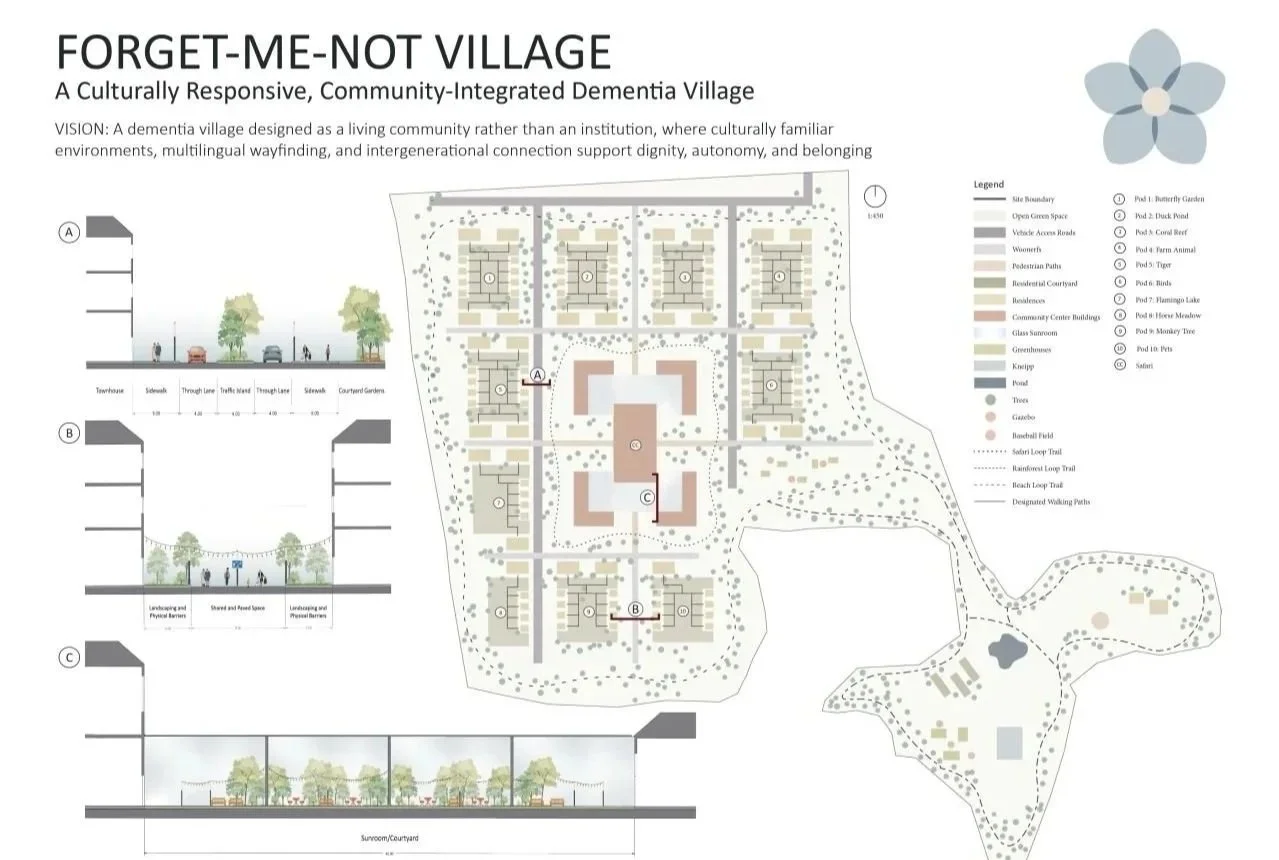
Forget-Me-Not Village site plan and sections.
The Reality of the Dementia Care Gap
As planning and design students, we can't ignore the numbers. Cities like London, Ontario, have some of the fastest-growing immigrant and minority populations in Canada. Yet, standard long-term care facilities follow rigid, one-size-fits-all programming that completely leaves out the cultural identities of racialized older adults.
When dementia progresses, individuals often switch back to speaking their mother tongue. In a conventional institutional home, if staff can’t speak that language, communication breaks down. This language loss drastically worsens feelings of vulnerability, anxiety, and isolation. On top of that, many immigrant communities face deep-rooted cultural stigmas around dementia, meaning families often shoulder caregiving duties alone to the point of complete burnout before finally seeking reactionary institutional placement.
We knew we needed to design a care framework that values a person's social and cultural growth, ensuring they feel a sense of belonging rather than isolation.
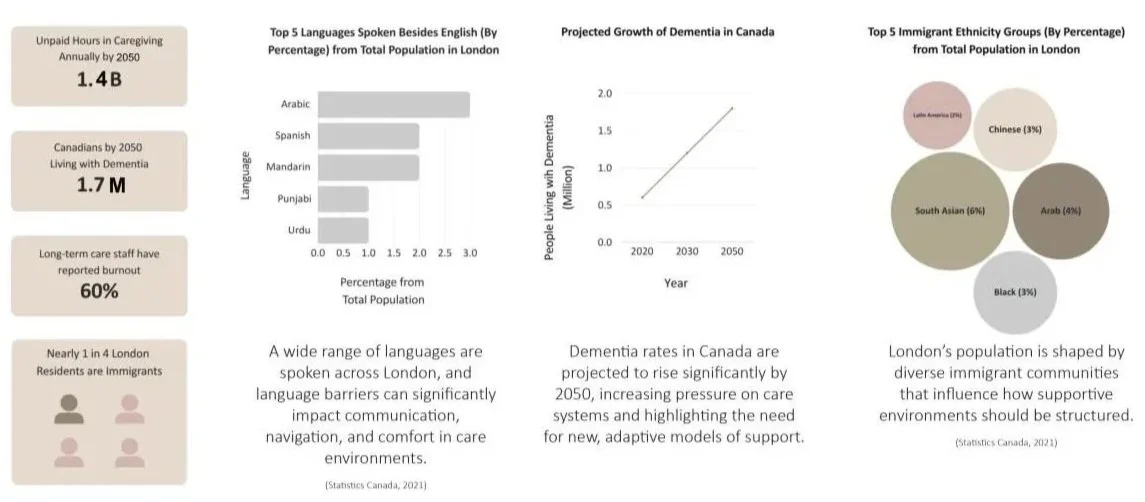
Demographic analysis.
Transforming Lived Experience into Spatial Moves
Named after the flower that symbolizes Alzheimer’s disease and enduring bonds, the concept site for Forget-Me-Not Village is situated at the intersection of Commissioners Road East and Wellington Road in London, Ontario. Nestled within London's healthcare corridor and adjacent to the therapeutic natural landscape of Westminster Ponds, the site offered the perfect canvas to integrate healthcare, nature, and the public realm.
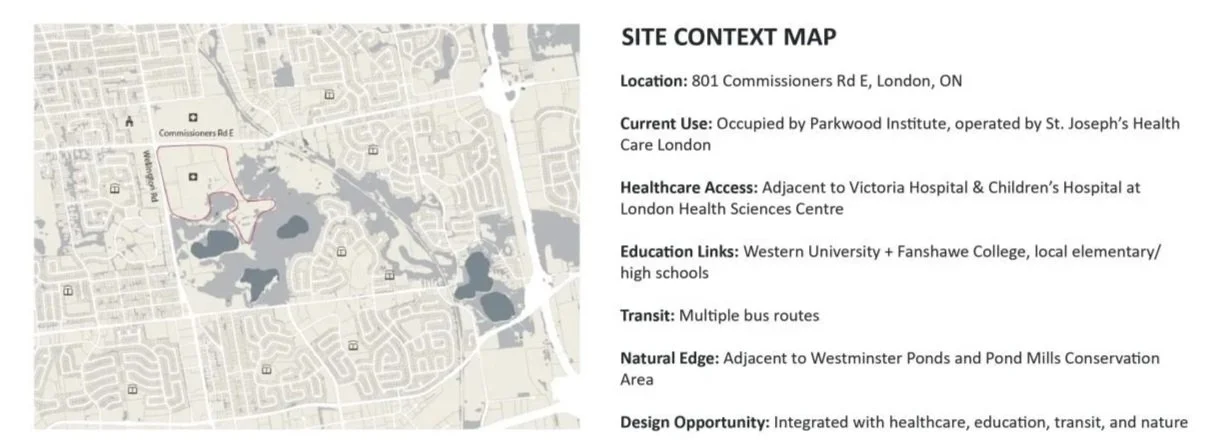
Site Map.
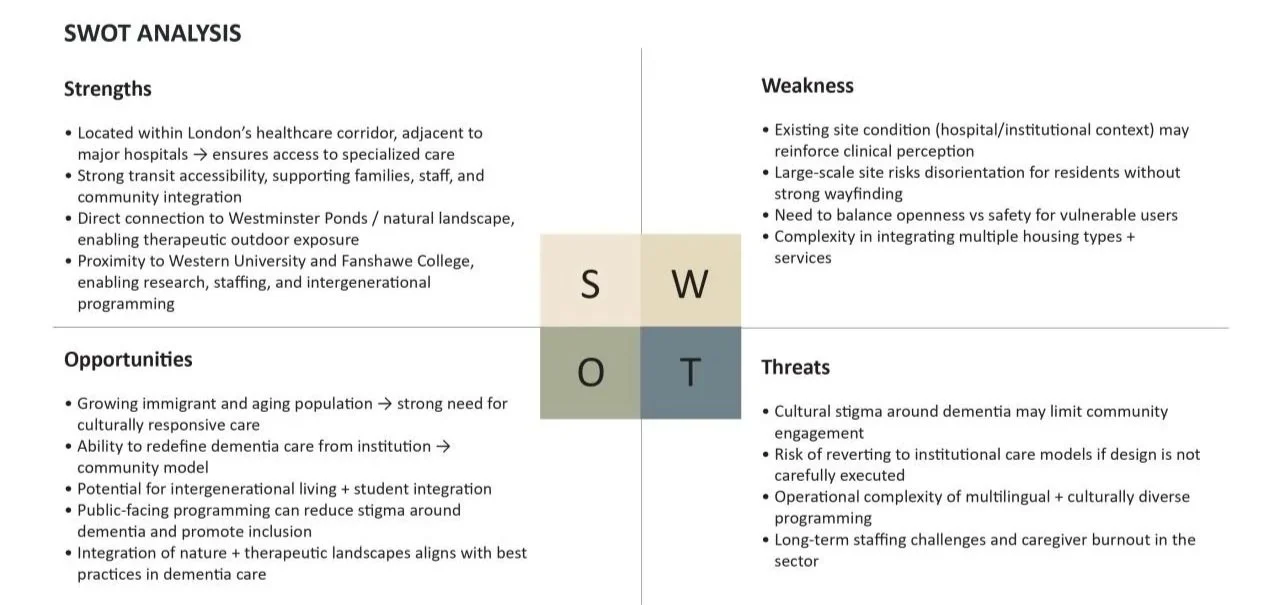
SWOT analysis informing the design logic framework.
Our design logic framework directly translates lived experience and community demographics into intentional spatial choices:
1. Multilingual Wayfinding
To handle language regression, our design moves away from text-heavy navigation. Instead, the village utilizes colour-coded pathways and a universal language of animal, flower, and landscape symbology. These visual cues provide intuitive navigation, lowering anxiety and reinforcing a sense of autonomy even as memory and language fade.
2. The "Market Lane" Woonerf
To strip away the institutional feeling of abandonment, we centred the village around vibrant Market Lanes. Accessible via pedestrian-first shared streets (woonerfs), this space includes a public-facing cafe, bookstore, grocery option, and communal kitchen. By pulling the broader London community into the village space through mixed-use streetfronts, we normalize the presence of those living with dementia and break down social stigmas.
3. Breaking Down Age Segregation: The Intergenerational Model
Many immigrant families thrive in multi-generational households. Our design supports this by offering housing typologies that allow families to accompany their loved ones. Furthermore, leveraging the site’s proximity to Western University and Fanshawe College, we integrated an innovative Student program. Health science, social work, and culinary students are provided work, internship, and co-op opportunities to ensure real-time learning and community interaction. This turns the village into a true "living classroom" where cross-cultural and cross-generational exchange happens naturally every day.
4. Honouring Cultural and Spiritual Routines
The central community center acts as a hub for culturally responsive programming. It features dedicated multi-faith prayer rooms to support diverse spiritual practices and communal kitchens where families can prepare culturally familiar meals.
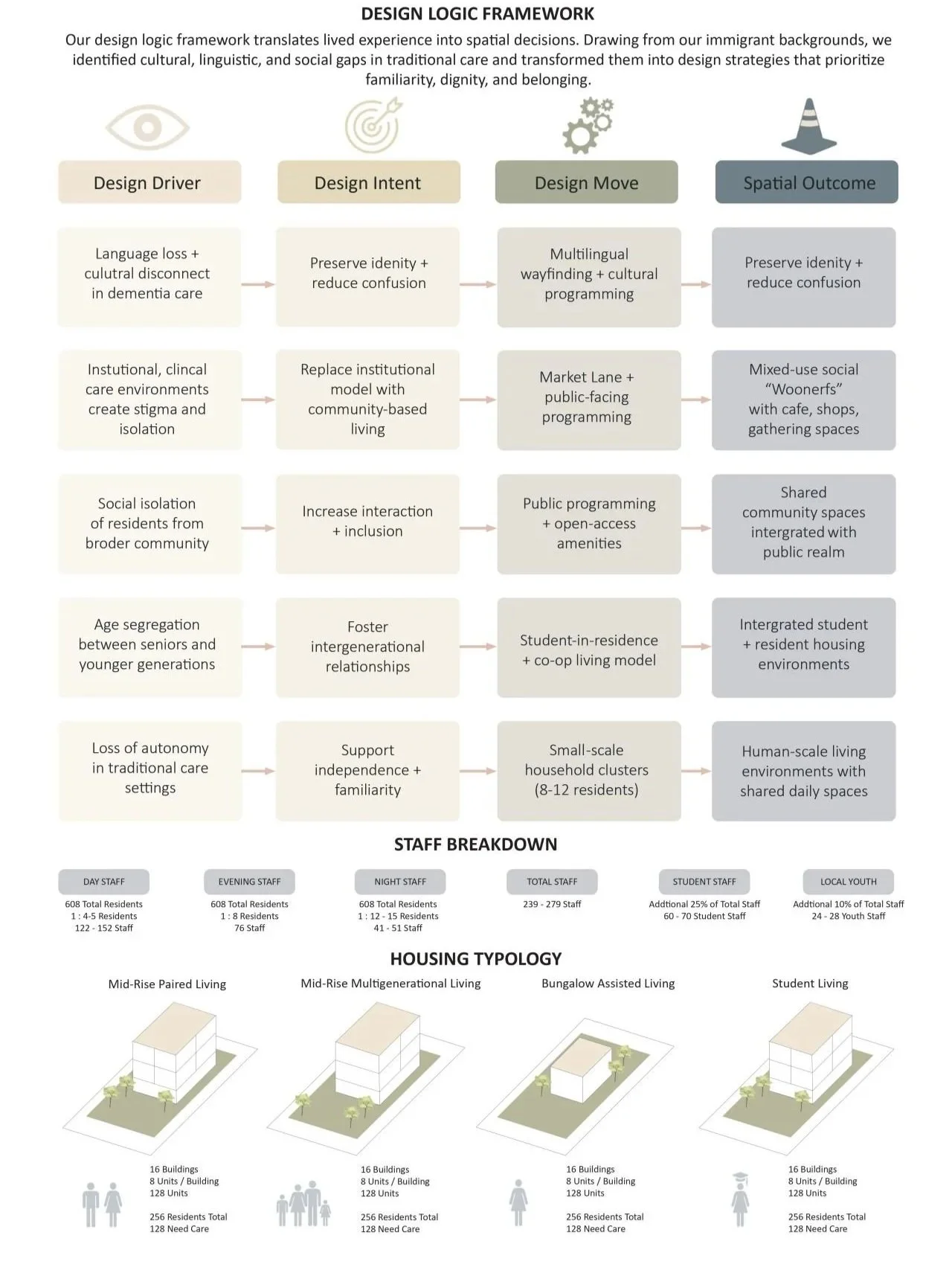
Design logic framework.
A Day in the Village: Putting People First
What does this look like in practice? We mapped out a "Day-in-the-Life" journey to visualize how our design impacts real people:
The Resident: Starts her morning walking down the pedestrian woonerf with her grandson Marcus to grab breakfast at the local cafe before heading to the prayer room. In the afternoon, she joins environmental science students to harvest squash in the village crops, bringing it to the communal pantry for an evening pair-cooking class.
The Student: A local high schooler who gets to eat breakfast with his grandma, swim in the community center pool, and volunteer alongside his friends to teach a computer class, helping residents virtually connect with their families overseas.
The Staff Member: Nurses and care workers have dedicated wellness lounges and on-site overnight staff quarters. Designing for the staff's mental rest is built into our architecture as a crucial step to reduce industry burnout and ensure sustainable, compassionate care.
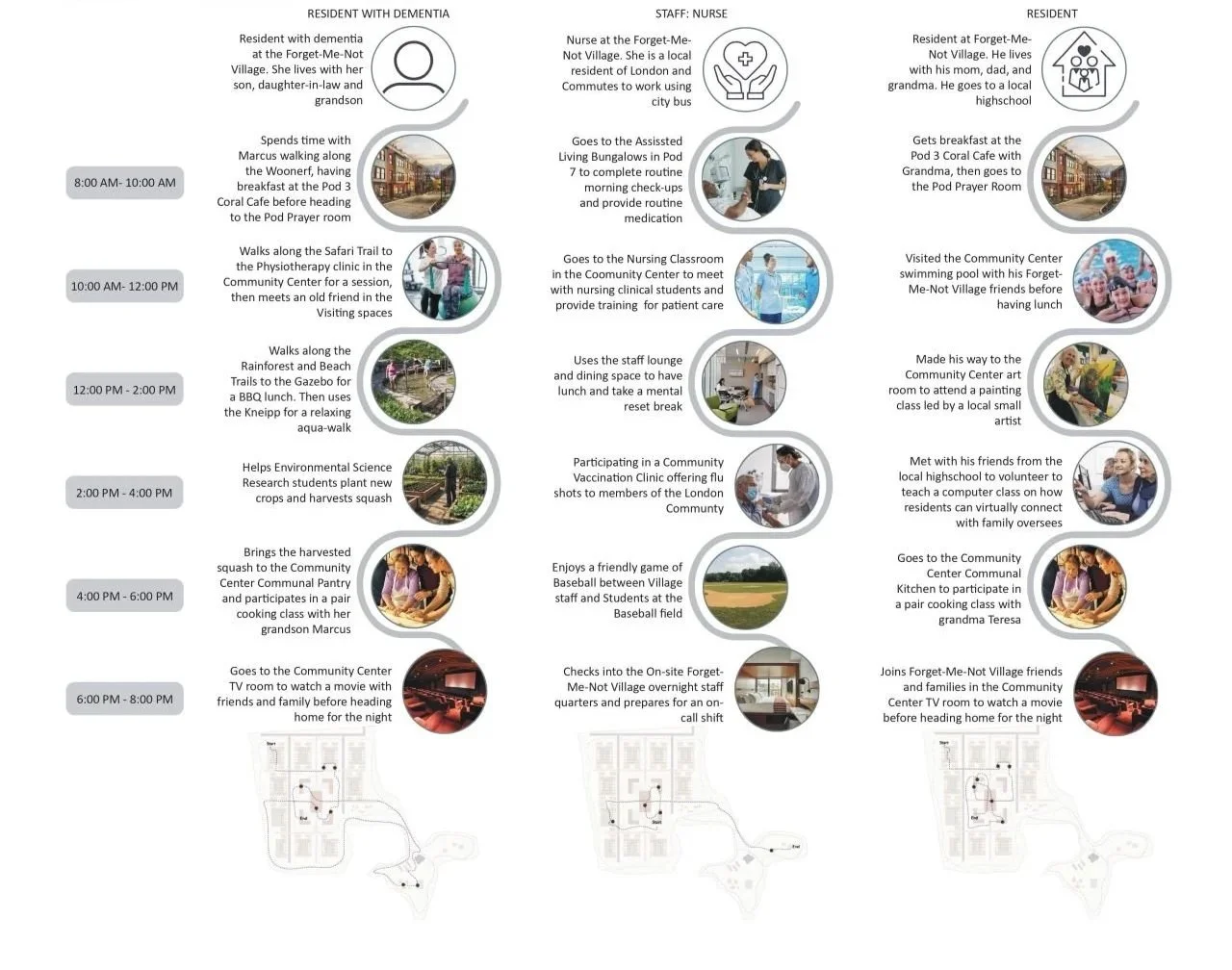
Day-in-life journey maps (Resident with Dementia, Staff/ Nurse, and Resident).
Final Reflections
Working on Forget-Me-Not Village was a poignant way for the three of us to cap off our undergraduate journey. It pushed us to realize that planning and design shouldn’t just be about zoning regulations, building forms, or cold, clinical spaces. Good design keeps people, their histories, and their relationships at the forefront.
While this project began as an academic concept, we see it as a very necessary, highly scalable framework for Canadian cities. By putting diverse immigrant and human experiences front and center, we can design spaces where memory care is no longer defined by what is lost, but by what is retained: dignity, culture, and a deep sense of belonging.
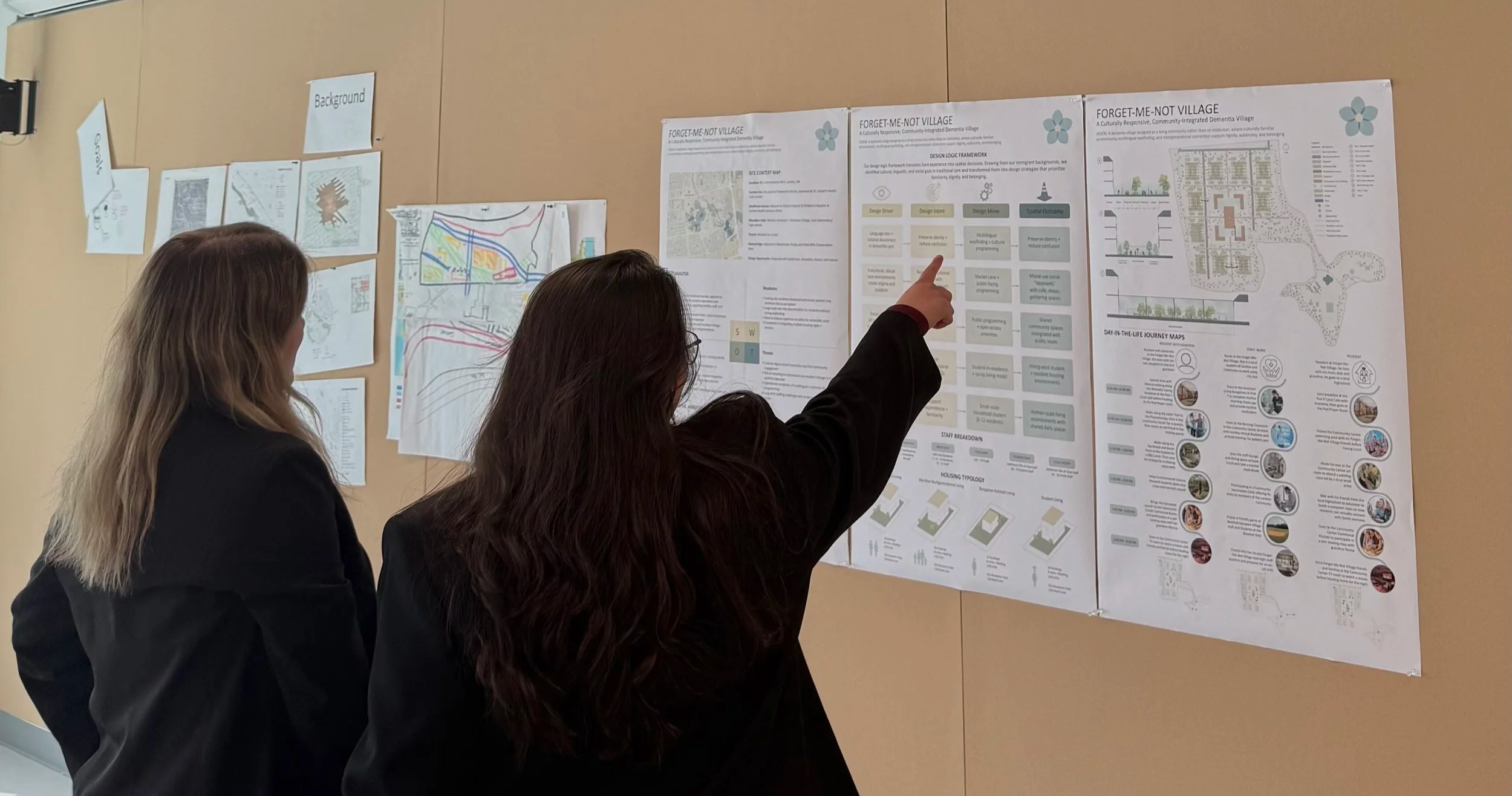
Forget-Me-Not Village looking at their panels.
Dhenu, Franziska and Keral’s submission to the Design Competition was supervised by Dr. Biglieri and Prof. Perez-Amado.